• About

Seeing The Earth

~ A fine WordPress.com site

Seeing The Earth

Category Archives: Cascade Mountains

Mount Hood: South Side (part one)

22 Wednesday Oct 2014

Posted by Jim Jackson in Cascade Mountains, Commercial Air Routes, Pacific Northwest, Volcanoes

≈ Leave a comment

Flights departing PDX for cities in Nevada, Arizona, and sometimes southern California pass the south flank of Mt Hood while climbing through ~20,000. From late October thru May you often see this view on the north side of the plane on a “clear” day:

MtHood 6Nov11

This picture was taken on November 11, 2012 on what passes for a clear autumn day in Portland. The upper 2500 feet on the south side are visible above the clouds.

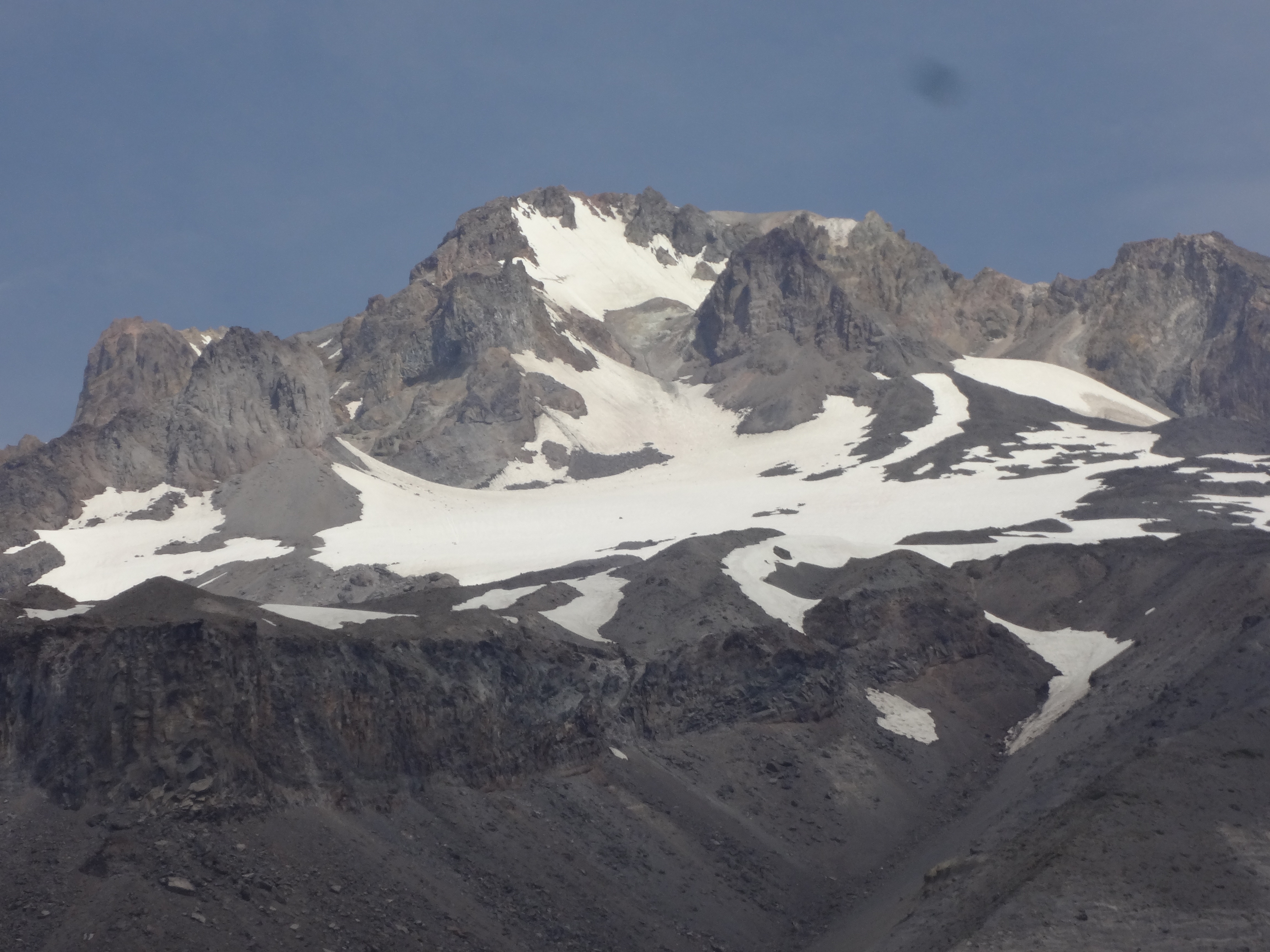
During the late summer, the snow fields melt away, as do the small glaciers. The view from the ground in September looks like this:
MtHood

This picture was taken from the Timberline Trail on the south side of the Zigzag River Canyon. The cliff in the foreground is the Mississippi Head. This is an intra-canyon lava flow that erupted during the Polallie eruptive period 13,000 to 20,000 years ago (Scott et al 1997). Lavas flow down slope from their vents. They enter stream valleys and follow these until they solidify. The Mississippi Head lava flow is within a valley (or  canyon) eroded into older mudflows, debris flows, and pyroclastic flows. It is overlain by young glacial drift and even younger volcanic deposits erupted during the Timberline (~1500 years ago) and Old Maid Flat (late 1800’s) events.

On the left skyline above Mississippi Head we see Yokum Ridge, an andesite lava flow that is about 303,000 years old. Just in front of Yokum Ridge is Illumination Rock, another Polallie period andesite flow. These two features are examples of “inverted topography”, a common topographic feature of volcanic regions. Just as the Mississippi Head lava flow filled an older canyon, both Yokum Ridge and Illumination Rock moved away from their summit area vents into valleys carved into the flank of Mt Hood. The material underlying the valley walls was easily removed by erosion. Over time, the valley walls were worn away by running water and mass wasting. The lava flows were more resistant to erosion, so they remained behind. T

hus a topographic valley was filled with lava, and following erosion the lava formed a ridge where the valley had been. The valley topography was thus “inverted” to become a ridge.

The summit ridge above Yokum Ridge and Illumination Rock consists of eroded dacite domes, lava flows, and possible eruptive vents. In many places, these are broken, or “brecciated”, by fractures. The fractures were conduits for volcanic gas to reach the surface. The area around the fractures is highly altered by the passage of the gasses.

The right skyline of the summit is known as the Steel Cliffs. This is an eroded lava dome that may be where the Polallie age volcanic rocks erupted.

Crater Rock is the dacite dome sitting in the middle of the summit area, below the summit ridge. This is the vent for the most recent eruptive event, the late eighteenth century Old Maid Flat eruption. Below the Crater Rock, the snow fields cover the volcanic debris shed from the vent. The debris forms a fan that extends from Crater Rock down the south side of Mt Hood to Timberline Lodge. It covers older lava flows, such as the one at Mississippi Head, as well as older debris flows that erupted from Mt Hood 1.5, 13 to 20, and 30 to 50 thousand years ago. Below these debris flows are older lava flows ranging from 200 to 500 thousand years ago.

Scott et al 1997 Geologic History of Mount Hood Volcano, Oregon-A Field Trip Guidebook. USGS Open File Report 97-263.

http://pubs.usgs.gov/of/1997/0263/report.pdf


Flying East from Portland: The Columbia River Gorge

05 Friday Sep 2014

Posted by Jim Jackson in America From the Air, Cascade Mountains, Commercial Air Routes, Pacific Northwest

≈ Leave a comment

PDX-ORD

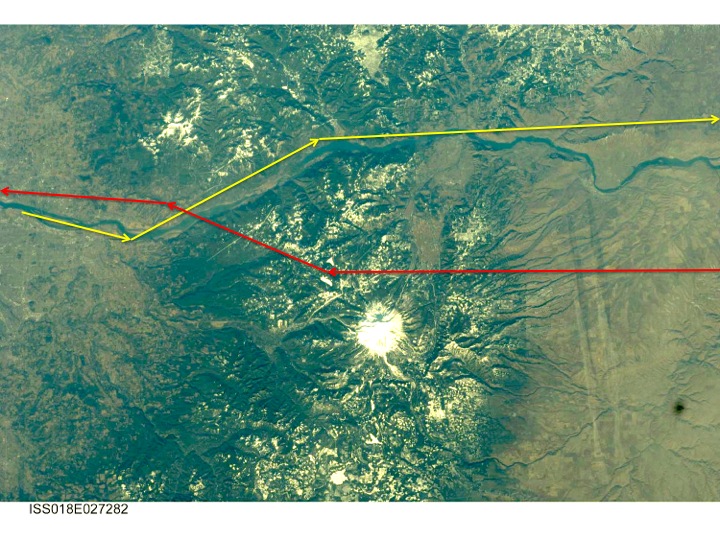
The image is from NASA’s Gateway to Astronaut Photography of the Earth:

http://eol.jsc.nasa.gov/

The line in yellow shows the east-bound flight path used today, the red line shows the west-bound flight path. Today the prevailing wind is from the east, so flights departing PDX take-off to the west, heading directly to the Columbia River Gorge. Arriving flights loop around Vancouver, Washington and north Portland before landing to the east.

The Columbia River cuts a valley through the Cascade range between The Dalles, Oregon, and the Portland suburb of Troutdale, Oregon. The south side of the Gorge is known for its waterfalls, including Oregon’s second most visited tourist attraction, Multnomah Falls. On a clear day, passengers will see Mt St Helens, Mt Rainier, and Mt Adams on the north side of the plane. Mt Hood, Mt Jefferson, and the Three Sisters are often visible on the south side.

In the middle of Gorge lies Bonneville Dam, build on the toe of a very large landslide. Stevenson Washington and Cascade Locks, Oregon are located east of the dam.Hood River, Oregon is near the east end of the Gorge. The town is within a broad valley that runs from Mt Hood to Mt Adams.

The Sandy River drains the west flank of Mt Hood and enters the Columbia River at the west end of the Gorge, just below Broughton Bluff.

SandyDelta


The Sandy is a small river subject to large variations in stream flow. Somehow, it has deposited a large delta across the much larger Columbia River. When the Lewis and Clark expedition encountered the river on November 3, 1805, naming it the quick Sand River. Their journal notes the river divided in two branches six miles upstream from the Columbia, thus creating an island where the present delta lies. The Corps of Engineers modified the Sandy’s two outlets to improve the smelt run, thus creating the delta seen today.

One would expect the much larger Columbia to remove the delta created by the smaller Sandy River, and yet we see that delta displaces the Columbia to the north. How can this be? The Sandy River delta is underlain by mudflows that originated on Mt Hood in association with several volcanic eruptions. The mudflows carried a great volume of volcanic debris off the mountain, and then the Sandy moved the sediments 50 miles to the Columbia. Thus the Sandy River Delta is a distant deposit from several of Mt Hood’s eruptions. The most recent eruption occurred about ten years before the Lewis and Clark Expedition traversed the Gorge.

The Cascade Range is named for a major rapids seen by the Europeans in the center of the Gorge. These “Cascades” are now submerged beneath the lake behind Bonneville Dam. The town of Cascade Locks serviced the locks that enabled small ships to move past the cascade.

BonnevilleDam

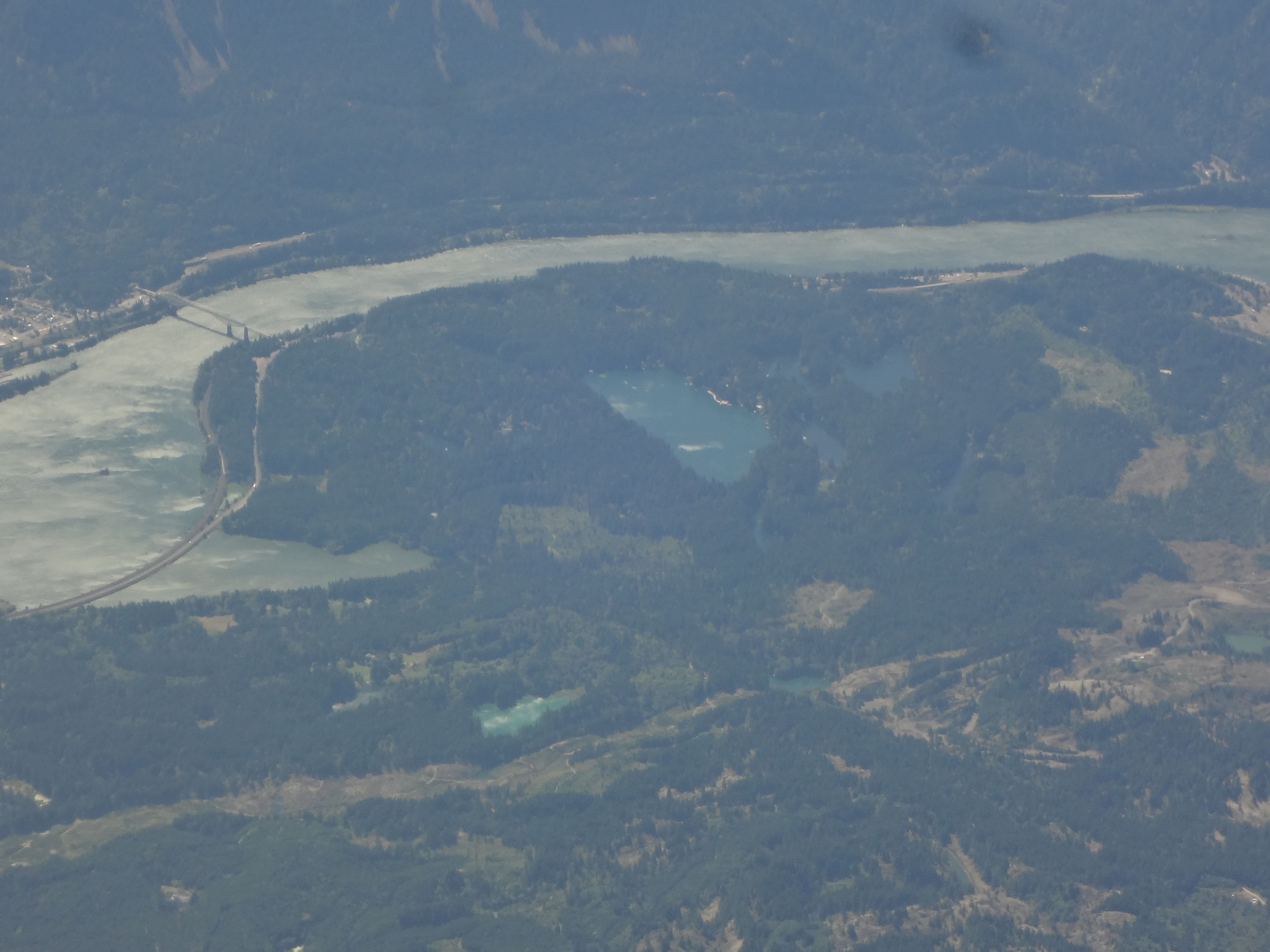
A large landslide crosses the Columbia at the cascades. Its headwall is on the Washington side of the river. The foot of slide includes several small lakes just north of the dam. The Bridge of Gods is upstream of the Bonneville Dam, at the west end of Cascade Locks.

BridgeGods

The bridge takes its name from a native account of a catastrophic movement on the slides that blocked the river, creating a temporary dam.

BonnDam

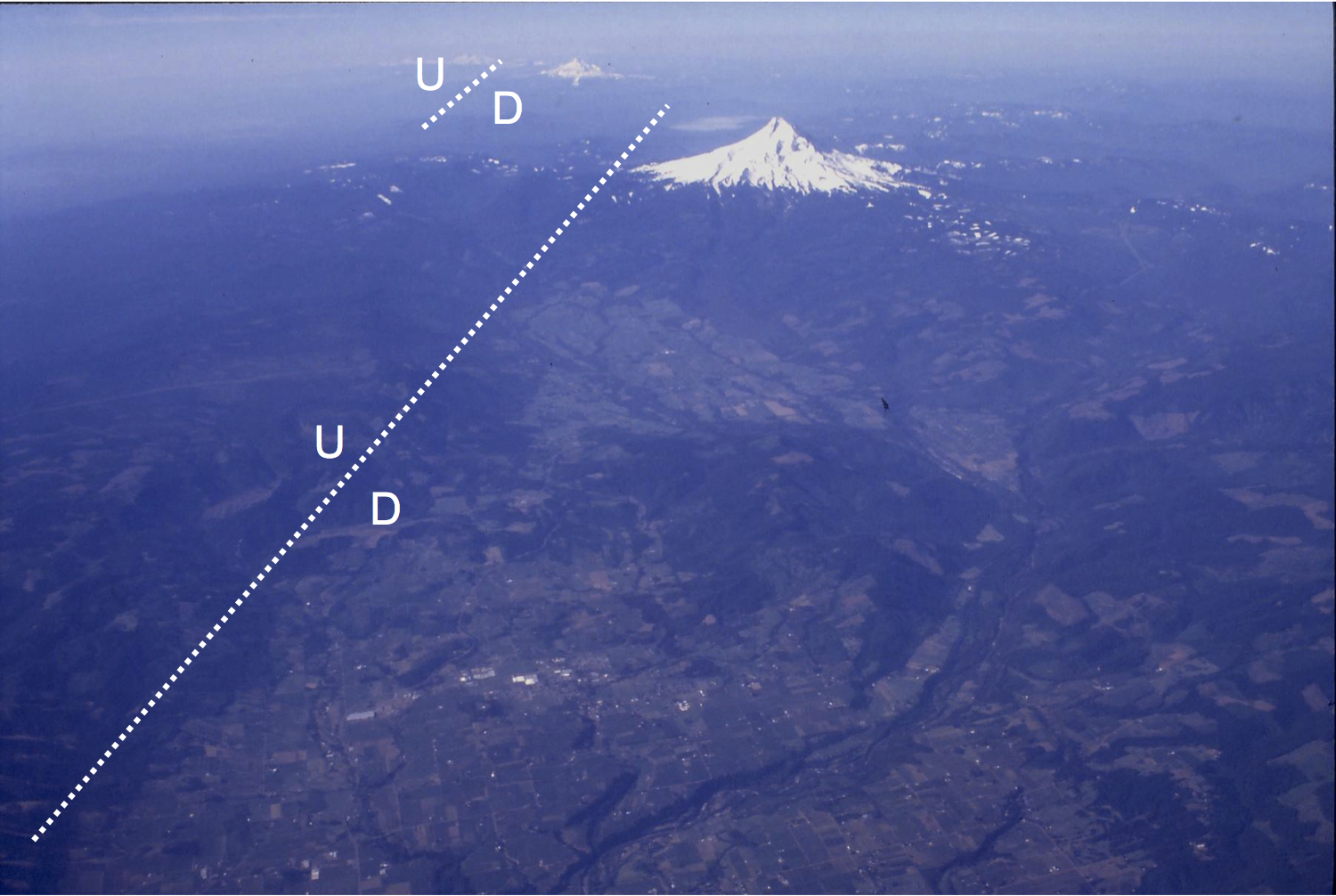
The small city of Hood River, Oregon is twenty-five miles east of Bonneville Dam. The Hood River Valley runs south from the city to Mt Hood. Fruit orchards are the main industry in the valley. The timber industry’s presence is revealed by the clear cuts in the nearby mountains. The east side of the valley is steeper than the west side. A fault runs along the east side of the valley, dropping the valley floor down several hundred feet. The fault is a major feature of the Oregon Cascades, and occurs south of Mt Hood to the east of Mt Jefferson.

HoodRValley


Beyond Hood River, the Gorge merges with the Yakima Foldbelt and the Columbia Platean.


Subscribe

  • Entries (RSS)
  • Comments (RSS)

Archives

  • October 2014
  • September 2014
  • August 2014
  • July 2014

Categories

  • America From the Air
  • Cascade Mountains
  • Commercial Air Routes
  • Pacific Northwest
  • Volcanoes

Meta

  • Create account
  • Log in

Blog at WordPress.com.

Privacy & Cookies: This site uses cookies. By continuing to use this website, you agree to their use.
To find out more, including how to control cookies, see here: Cookie Policy
  • Subscribe Subscribed
    • Seeing The Earth
    • Already have a WordPress.com account? Log in now.
    • Seeing The Earth
    • Subscribe Subscribed
    • Sign up
    • Log in
    • Report this content
    • View site in Reader
    • Manage subscriptions
    • Collapse this bar
 

Loading Comments...